
The vegetation in Lake Nakuru National Park is mainly a mix of woodland and bushy grassland. The park has several types of habitats, from the lake waters to the surrounding escarpments and ridges.
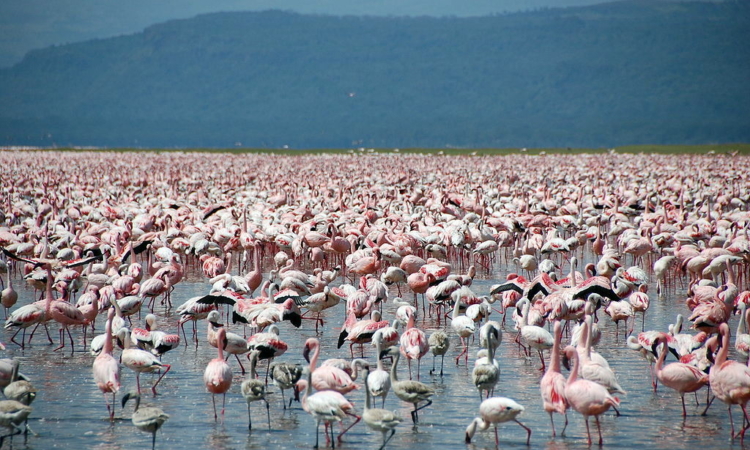
The lake itself covers about one-third of the park. Its water supports a dense growth of the blue-green algae Spirulina platensis, which gives the lake its color. This algae is the main food source for the flamingos that are often seen along the lake’s shores.
Around the lake, there are alkaline swamps with plants like sedges, Cyperus laevigatus, and Typha marshes found near the river inflows and springs. Further out, the land changes into dry savanna, starting with salt grasses like Sporobolus spicatus near the lake and turning into open grasslands with Hyparrhenia hirta and Chloris gayana (Rhodes grass) in the lower areas.
Higher parts of the park are covered by dry forests, including trees like yellow-barked Acacia xanthophloea, wild olive (Olea hochstetteri), and Croton dichogamus. There are also forests of Euphorbia candelabrum, and bushland areas with shrubs like Tarchonanthus camphoratus (locally called Mulelechwa) and Psiadia arabica.
The rocky hillsides on the eastern side of the park are covered with Tarchonanthus scrub and Euphorbia candelabrum forest.
The name “Nakuru” means “Waterbuck Haven” in Kiswahili. The park started small, protecting only the lake and nearby hills. Today, the fenced park covers about 90 square miles. It has unique vegetation and is home to over 400 bird species, many of them migratory.
Lake Nakuru is a shallow, strongly alkaline lake covering about 62 square kilometers. The landscape includes marshes, open grasslands, rocky cliffs, acacia woodland, and Euphorbia forest on the eastern edge. Surrounding landmarks include the Bahati Hills to the northeast, Lion Hill to the east, Eburu Crater to the south, and the Mau Escarpment to the west.
Three main rivers – Njoro, Makalia, and Enderit – flow into the lake, along with treated wastewater from the nearby town and natural springs along the shore.
Lake Nakuru was first declared a bird sanctuary in 1960 and became a national park in 1968. The base of the park’s food chain is Spirulina platensis, which supports the large population of lesser flamingos found here.